
The Switches I Didn't Expect From Ubiquiti
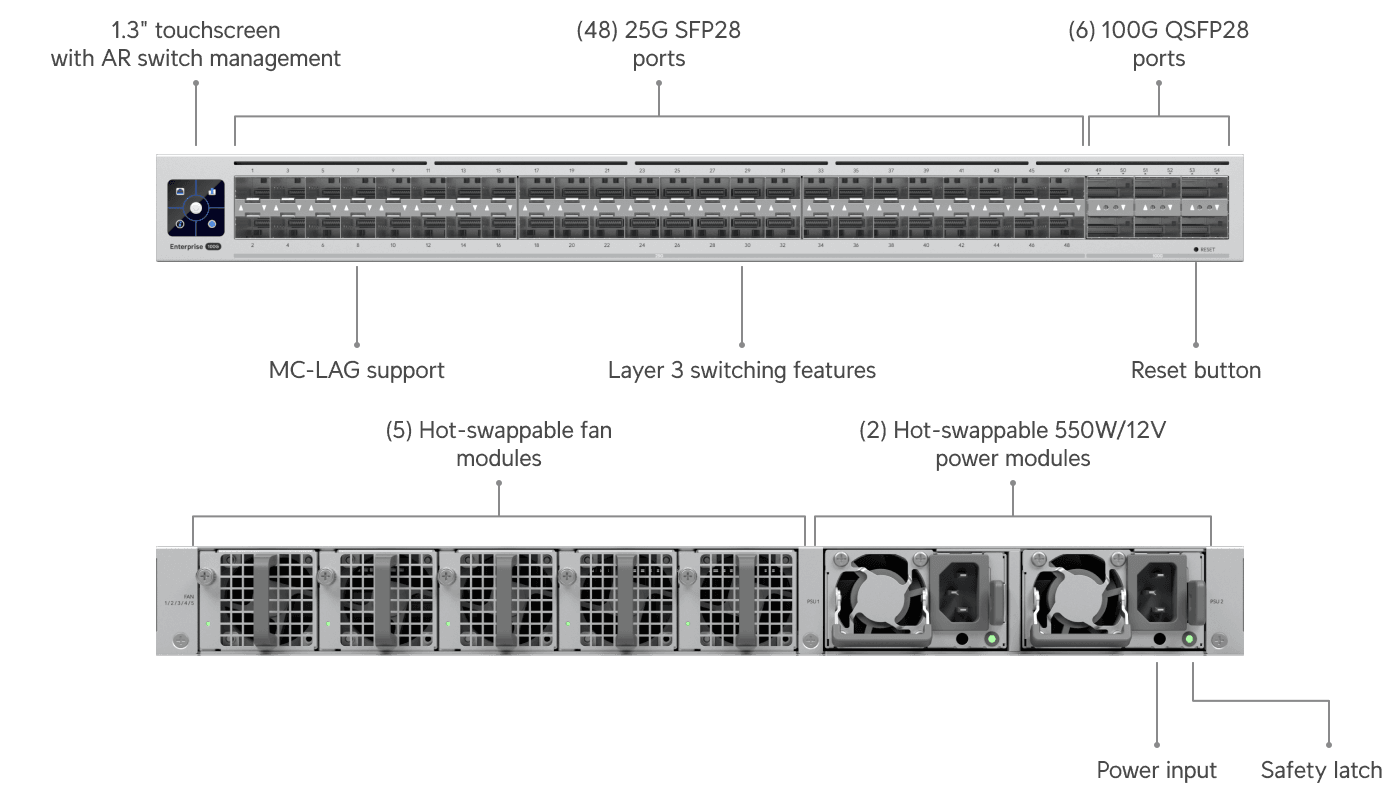
On September 2, Ubiquiti pushed out UniFi Network 10.6.101 and, buried in the changelog, added support for two new switches: the ECS-24S-PoE and the ECS-48S-PoE. Enterprise Campus is a new line for Ubiquiti, and after reading the spec sheet twice I'm convinced these are the most serious pieces of switching hardware the company has ever shipped under the UniFi banner. Real Layer 3 routing, real stacking, and 100G QSFP28 uplinks. Not "100G-ready." Actual 100G ports, two of them, on a switch that costs less than a decent GPU.
I've run UniFi gear in my rack for years because the management plane is good and the price is right, but I've always kept the actual routing and inter-VLAN heavy lifting on something with a real ASIC behind it. These two switches are the first UniFi products where I'd consider trusting the switch itself with that job.
The Numbers That Matter
The ECS-48S-PoE is the flagship: 48 PoE+++ ports (one 1GbE, thirty-two 2.5GbE, sixteen 10GbE, all capable of up to 90W per port), four 25G SFP28 uplinks, and two 100G QSFP28 ports for core connections. Switching capacity is rated at 680 Gbps with 340 Gbps of non-blocking throughput and a forwarding rate of 506 Mpps. The PoE budget tops out at 2,150W across dual hot-swappable 1,200W power supplies, backed by four hot-swap fans, which tells you this thing is built to run in an actual comms room, not a closet.
The smaller ECS-24S-PoE trims the 2.5GbE port count to eight and the 10GbE count stays at sixteen, with the same four 25G SFP28 and two 100G QSFP28 uplinks. Switching capacity drops to 460 Gbps with 230 Gbps non-blocking and 342 Mpps forwarding. PoE budget starts at 1,050W with the base dual 600W supplies and scales to 2,250W with the optional 1,200W modules. Both switches support stacking across two units with cross-stack LAG, and both require UniFi Network 10.6.101 or newer, so if you're still on an older controller build, budget time for the upgrade before the hardware shows up.
Why the 100G Uplinks Actually Change the Math
Most "prosumer" switch lines top out at 25G or 40G uplinks and call it a day, because the market for 100G at the edge has historically been enterprise-only and priced accordingly. Putting 100G QSFP28 on a sub-$4,000 access switch means you can now run a proper leaf-spine setup in a home lab or small business without touching Arista or Juniper pricing. Two 100G ports per switch also means you can dual-home each access switch to a spine for redundancy without burning your only fast uplink on failover.
For anyone running a homelab with a few dozen VMs, a NAS doing 25GbE, and a growing pile of PoE cameras and APs, this closes a real gap. You no longer need a separate aggregation switch just to get beyond 10G between racks.
Where This Leaves Cisco and Aruba
Do the arithmetic and it gets uncomfortable for the incumbents fast. The ECS-48S-PoE works out to roughly $83 per port at $3,999 for 48 ports; the ECS-24S-PoE comes in at about $125 per port at $2,999 for 24 ports. A comparably specced Catalyst or Aruba CX switch with true Layer 3 stacking, 2,000W-plus of PoE budget, and 100G uplinks routinely lists well north of that per-port cost before you've even added a support contract. Ubiquiti isn't going to unseat Cisco in a data center anytime soon, but for the SMB and prosumer segment where budget genuinely dictates the network topology, this is a meaningfully better offer than it was a week ago.
The Catch
None of this matters if the firmware doesn't hold up under real Layer 3 load, and UniFi's routing stack has a track record of being fine for VLANs and static routes but occasionally rough around the edges on anything more exotic, like OSPF at scale or complex ACL chains. Ubiquiti's own listing only claims static routing for local networks on these switches so far, not full dynamic routing, which tempers my enthusiasm somewhat. I'd want to see these under sustained 10G+PoE load for a few months before recommending anyone rip out an existing core switch to replace it with one of these.
Verdict
If you've been waiting for UniFi to grow up past "good enough for a home network," this is the closest it's come. Stack two ECS-48S-PoE units, run your VLANs and firewall rules the way you already do in UniFi Network, and you've got a genuinely enterprise-capable core for less than the cost of one mid-range GPU. Just keep your eye on how the Layer 3 stack behaves once you push it past basic routing. If it's not on your own hardware, and now that hardware can actually route real traffic, it's finally starting to feel like yours.
Loading comments...