
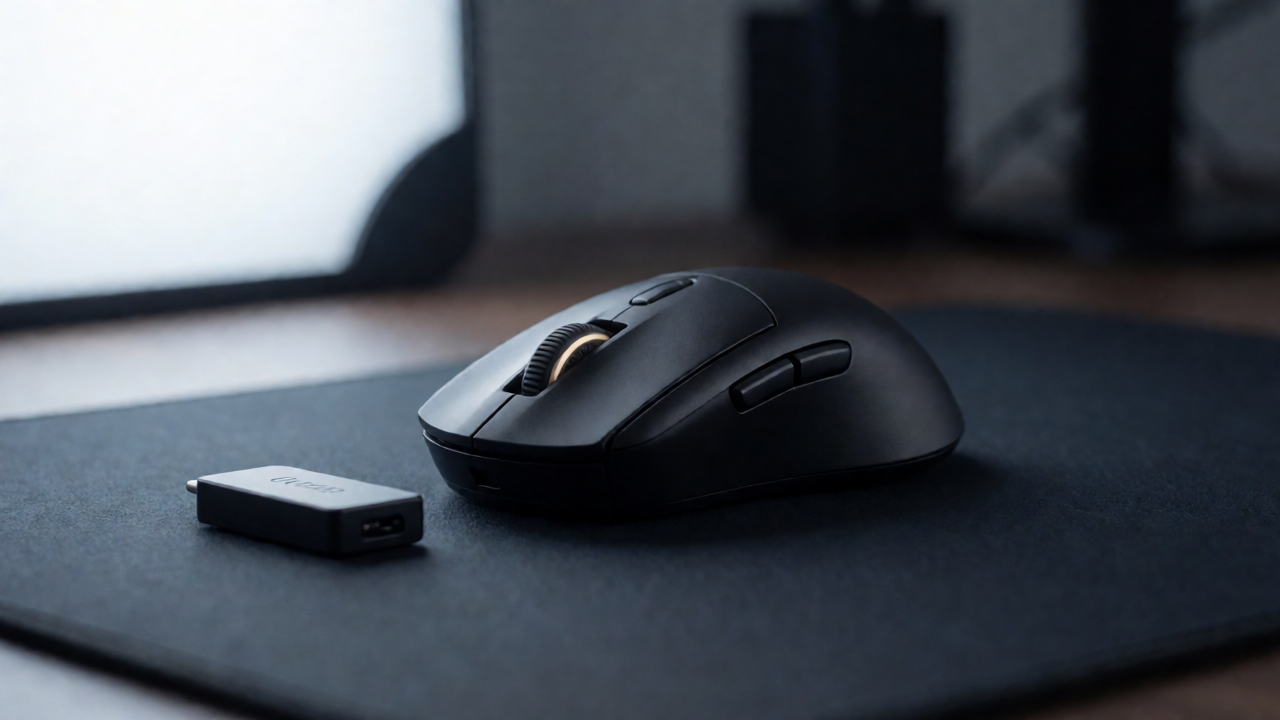
Another SteelSeries Mouse Beat Its Own Marketing Team to the Punch
A Reddit user got their hands on a Rival Pro Mini that shouldn't have been anywhere near the public yet, and the internet did what it always does with unreleased hardware: tore it apart for specs. What came out of that teardown is genuinely interesting, not because 49 grams is some record-breaking number in 2026, but because SteelSeries apparently skipped 2.4GHz entirely and went straight to ultra-wideband (UWB) wireless. That's a bigger deal than the weight class.
For context: I've spent a decade caring way too much about the difference between a mouse that reports position every 1ms and one that reports every 0.125ms. So when a major brand, not a boutique like Waizowl, decides 2.4GHz isn't good enough anymore, I pay attention.
Why Ditch 2.4GHz At All?
2.4GHz has been the backbone of wireless gaming peripherals since Logitech's original Lightspeed dongle, and it still works fine for most people. The problem is the neighborhood it lives in. The 2.4GHz ISM band spans roughly 83.5MHz of spectrum, and that tiny sliver is shared by your Wi-Fi router, your Bluetooth headset, your neighbor's smart plugs, and every other 2.4GHz mouse and keyboard within thirty feet of your desk at a LAN. At 8000Hz polling, your mouse is shouting its position at the receiver 8,000 times a second into a room full of other devices doing the same thing on adjacent channels.
UWB solves the crowding problem by moving to a completely different, and much wider, chunk of spectrum. SPARK Microsystems' implementation, which Elecom used first in the VM800 and Waizowl used in the Cloud Ultra, operates across roughly 7.25 to 9.30GHz, a band over two gigahertz wide. Compare that to the 83.5MHz you get on 2.4GHz and the difference in available room is not subtle.
The Numbers That Actually Matter to a Competitive Player
The leaked Rival Pro Mini specs line up with what you'd expect from a 2026 flagship: PixArt PAW3950 sensor, 8000Hz wireless polling, optical switches rated for 100 million clicks, and full PTFE skates. The one carryover from the Model O3 Wireless playbook is the "Infinite Power" swappable battery system, so you're not stuck charging mid-session if the pack dies during a tournament.
What's missing from the leak is the part I actually care about most: independent click latency and packet loss numbers under real interference. SPARK's own marketing claims sub-1ms response times and near-zero dropped reports even in crowded RF environments, but that's the vendor talking. Elecom's VM800 shipped first with this tech and reviewers who tested it in busy apartment buildings and LAN environments reported fewer of the micro-stutters you occasionally get from 2.4GHz mice fighting for a clean channel. I want to see the Rival Pro Mini put through the same wringer before I call this an upgrade rather than a marketing angle.
Shape Talk: This Isn't a Rival, It's a Prime in Disguise
Anyone who's held an actual SteelSeries Rival knows the family has a distinct, slightly boxy shape with a pronounced hump. The leaked Pro Mini doesn't match that at all. The photos floating around show something closer to the SteelSeries Prime's low, symmetrical profile: flatter front, narrower waist, sides that taper for a fingertip or claw grip rather than the palm-heavy Rival shell. If you're a Rival loyalist expecting a shrunk-down version of your current mouse, temper expectations. This is a Prime successor wearing a Rival badge, and the shape difference will matter more to your aim than the wireless protocol will.
Where This Leaves the Market
Three UWB mice in a single year, from Elecom, Waizowl, and now SteelSeries, is enough to call this an actual trend rather than a gimmick from a boutique brand chasing headlines. None of the big three, Razer, Logitech, or Corsair, have announced UWB hardware yet, and their existing Lightspeed and HyperSpeed 2.4GHz stacks are already excellent, so I don't expect a rushed response. But if SteelSeries proves the tech holds up in crowded RF environments without adding cost or latency, expect it to show up in every flagship wireless mouse by 2028.
No pricing or release date has leaked yet, and SteelSeries hasn't commented on the accidental early listing. Until independent testing lands, treat the UWB claims as promising on paper. Every millisecond is a missed headshot, and I'm not crowning a new wireless standard until someone puts a latency analyzer on it.
Loading comments...