
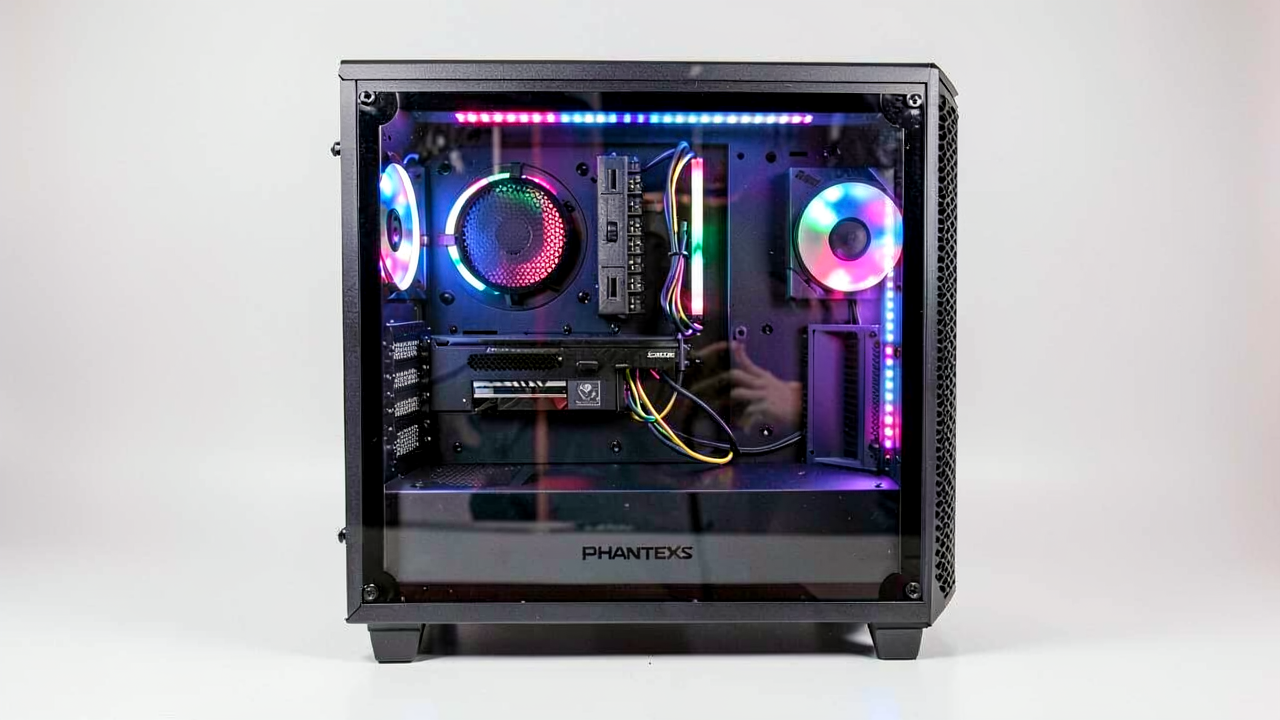
Finally, a Case Vendor Reads a Thermodynamics Textbook
Most case launches this year have been variations on the same theme: mesh front, three intake fans in a row, one exhaust out the back, call it a day. Phanteks just shipped something structurally different with the EX6 and EX6 Max, and it is the first mainstream chassis redesign in a while that actually changes the airflow topology instead of just the aesthetic wrapper around it.
The core idea is compartmentalization. Instead of one shared plenum where cold intake air mixes with whatever the GPU and VRMs have already heated up, the EX6 splits the interior into isolated zones. The CPU, GPU, and PSU each get their own path to fresh, non-recirculated air. A single side-mounted fan is dedicated to the motherboard tray, handling VRM and M.2 exhaust separately from the rest of the case. That is a real change to the flow network, not a marketing relabel of the same three-fan intake wall.
Why Isolation Matters More Than Airflow Volume
Airflow is not optional, it's physics, and the physics here is straightforward: CFM numbers on a fan box mean nothing if the air a component breathes has already been preheated by its neighbor. In a conventional shared-chamber case, GPU exhaust routinely gets pulled back into CPU cooler intake, and PSU intake pulls from the same warm air pocket sitting above the GPU. Every degree of preheat you avoid is a degree of headroom you get back on fan curve, and therefore on noise.
Segregating the PSU into its own zone is the detail I care about most. PSU intake temperature directly affects both the internal fan curve and the long-term life of the capacitors, and PSUs are usually the component stuffed into whatever leftover warm air a case has lying around. Giving it a dedicated fresh-air path, instead of scraps from GPU backpressure, is the kind of decision that shows up in a thermal camera at idle and light load, well before you get anywhere near a stress test.
GPU Clearance and the 358mm Reality
The EX6 supports GPUs up to 358mm, which is a tacit admission that the modern flagship card is closer to a small appliance than an expansion slot occupant. A dedicated GPU chamber with its own fresh-air feed is the right response to that trend line: as cards get physically larger and draw more power through a single connector, giving that connector's load its own convection path instead of sharing air with the CPU cooler reduces the odds of thermal throttling cascading between components that have no business affecting each other.
The EX6 Max: Justified Complexity, For Once
The EX6 Max adds a 90-degree custom AIO, pre-installed X30 fans, and a 10-inch, 1600x720 LCD panel for $329.99, against $159.99 for the base EX6 in Stone Gray. Normally I am skeptical of case-integrated AIO and display packages, since they tend to lock you into a vendor's cooler ecosystem and add failure points for the sake of a screen nobody needs. Here, the 90-degree AIO orientation looks like it is actually serving the compartment layout rather than fighting it, keeping the radiator and pump routed within the CPU's isolated zone instead of crossing into GPU airflow. That is a case where the added complexity has a thermal justification, not just a retail markup.
What I Want to See on the Bench
None of this replaces actual measurement, and Phanteks has not published independent thermal or acoustic data yet, so treat the isolated-zone claim as an engineering thesis until it is verified. When units ship, the tests that matter are GPU hotspot delta versus a shared-chamber case at equal fan RPM, PSU intake temperature under sustained transient load, and dBA at the same cooling performance point rather than at the same fan speed, since a compartmentalized design should let you hit the same junction temperatures at a lower RPM if the isolation actually works as described. If the numbers hold up, this is the layout other case vendors should be copying instead of another mesh panel refresh.
Loading comments...