
The Low-Profile HE Moment Has Finally Arrived
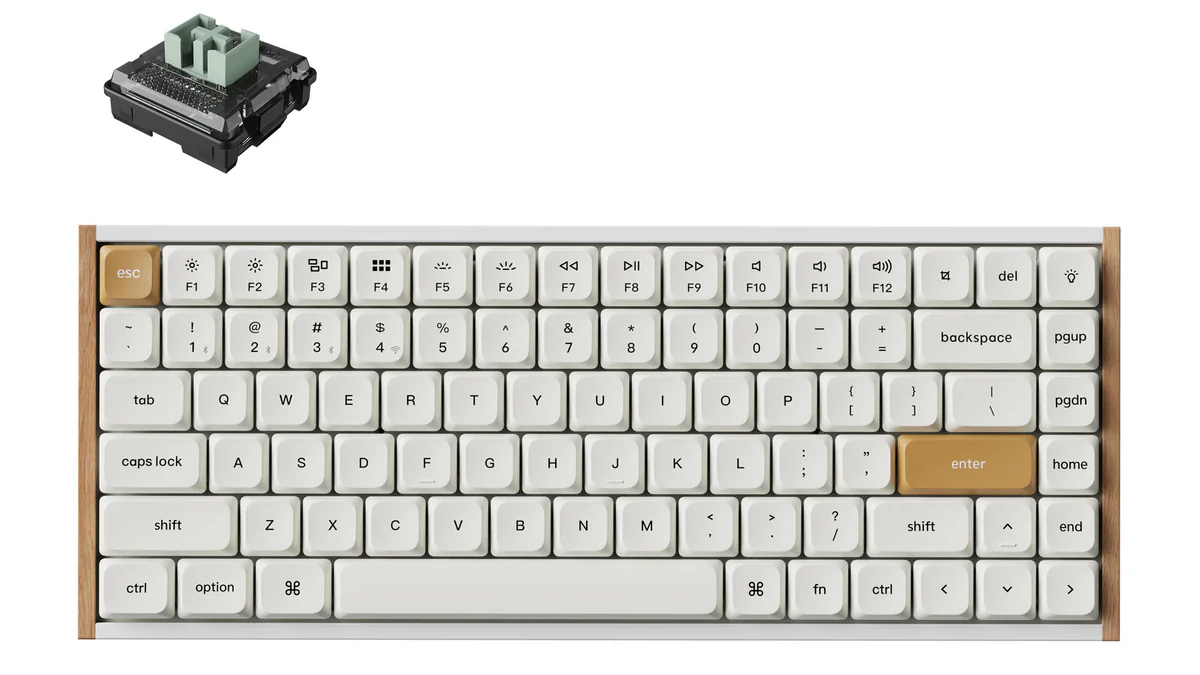
For years, the Hall Effect revolution has been a full-height affair. Wooting, NuPhy, Keychron's own Q-series HE boards, all tall switches, all built for desks with vertical real estate to spare. Low-profile Hall Effect boards existed at the margins, but they came with compromises: limited software, sketchy wireless, switches that felt more like membrane than mechanical. That changes today. Keychron has launched the **K3 HE** and **K3 Ultra 8K**, two 75% low-profile boards with rosewood accent pieces and Kickstarter pricing starting at $105. The campaign cleared $55,000 in its first day. The market has spoken.
K3 HE: Rapid Trigger Gets Compact
The K3 HE runs Keychron's Ultra-Fast Lime Low-Profile Hall Effect switches with 2.9mm total travel and minimum actuation down to **0.2mm**. The full competitive feature stack is here: adjustable actuation point, Rapid Trigger, SOCD (Simultaneous Opposing Cardinal Directions), DKS (Dynamic Keystroke), analog input support, and macro recording. All of it lives in Keychron Launcher, their browser-based configuration tool that doesn't need a local install. Wireless connectivity covers USB-C, 2.4 GHz, and Bluetooth 5.3, with a 1000 Hz polling rate over USB and 2.4 GHz.
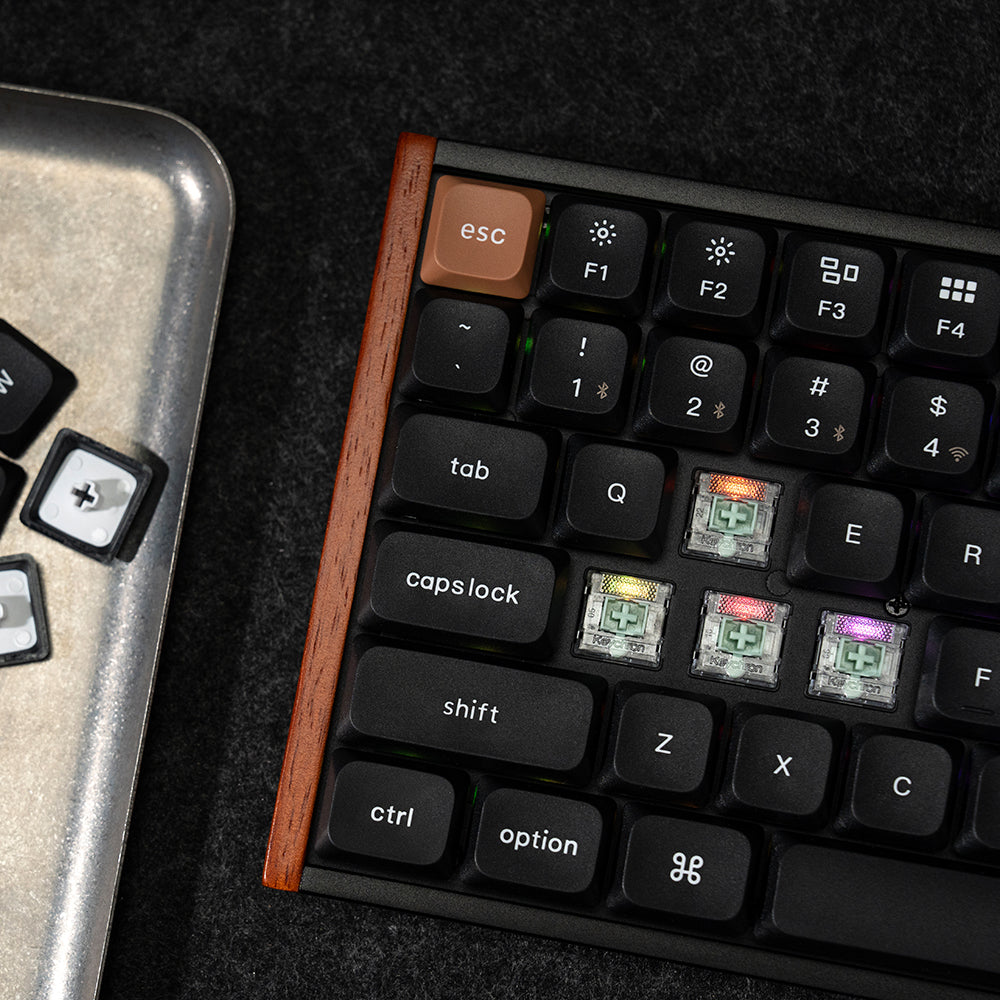
Thock is a feeling, not a sound, and low-profile changes the entire sensory signature. The shorter pre-travel and reduced bottom-out distance give the K3 HE a snappier, more immediate character than a full-height HE board. The Ultra-Fast Lime switches are tuned light, which makes sense for rapid trigger gaming, but desktop typists who bottom-out hard will want to give these a long demo before committing. The 0.2mm minimum rapid trigger sensitivity is competitive, if not quite at Wooting's 0.1mm floor, but for most people, the practical difference between 0.1mm and 0.2mm sensitivity exists only on paper.
K3 Ultra 8K: When Battery Life Is the Feature
The K3 Ultra 8K takes the opposite philosophy. Swap the Hall Effect sensors for Gateron Low-Profile 2.0 switches, available in Milk POM Red, Brown, or Banana, and suddenly you can push polling to **8000 Hz** over USB-C and 2.4 GHz wireless. That puts it in rare company: genuinely wireless keyboards with 8K polling support are still scarce in 2026. Bluetooth drops the polling to 133 Hz, as physics demands.
The headline stat for the Ultra is battery. A 2600 mAh cell combined with the power-efficient mechanical switches delivers **550+ hours** of wireless runtime. The K3 HE, with its Hall Effect sensors drawing continuous power, gets a respectable but comparatively modest 55 hours. Neither figure is theoretical worst-case. Keychron's conservative testing methodology has historically matched real-world usage closely. The weight comes in at 575g, reasonable for a board of this spec density.
Build Quality: ABS, Aluminum Rails, and Actual Wood
Both boards share the same structural DNA. ABS base, aluminum top rails, and genuine rosewood accent strips along the sides. The wood isn't cosmetic filler; it adds mass in a position that shifts the board's resonance character, taking the edge off ABS hollowness in a way that no amount of foam dampening fully replicates. Internal noise dampening layers handle the rest of the sound profile work. Keychron ships a screwdriver in the box, which is a quiet acknowledgment of who their buyers are and what they do to keyboards.
Keycaps are double-shot PBT in Keychron's LSA (Low-Spherical Arc) profile, a custom profile designed for the height constraints of low-profile switches with a slight spherical sculpting that distinguishes it from flat laptop-cap profiles. It's not as iconic as SA or Cherry, but it's tactile, durable, and feels genuinely premium for this price bracket. Typing angles are adjustable at 2°, 4.5°, and 7.5° via built-in feet on the K3 Ultra.
The Price Argument
At $115 early bird for the K3 HE and $105 for the K3 Ultra 8K, these are competitive against nearly anything in their respective niches. The Kickstarter cleared its $10,000 goal by more than 5x on day one. At retail, prices will likely settle around $120–$130, and even at that range you're getting Hall Effect rapid trigger (or 8K wireless polling), triple connectivity, double-shot PBT, and a board that doesn't look like it was designed by someone who hates aesthetics. The low-profile HE segment has needed a credible mainstream entry point. The K3 HE looks like it.
Loading comments...