
A Fourth Name on the DRAM Spec Sheet
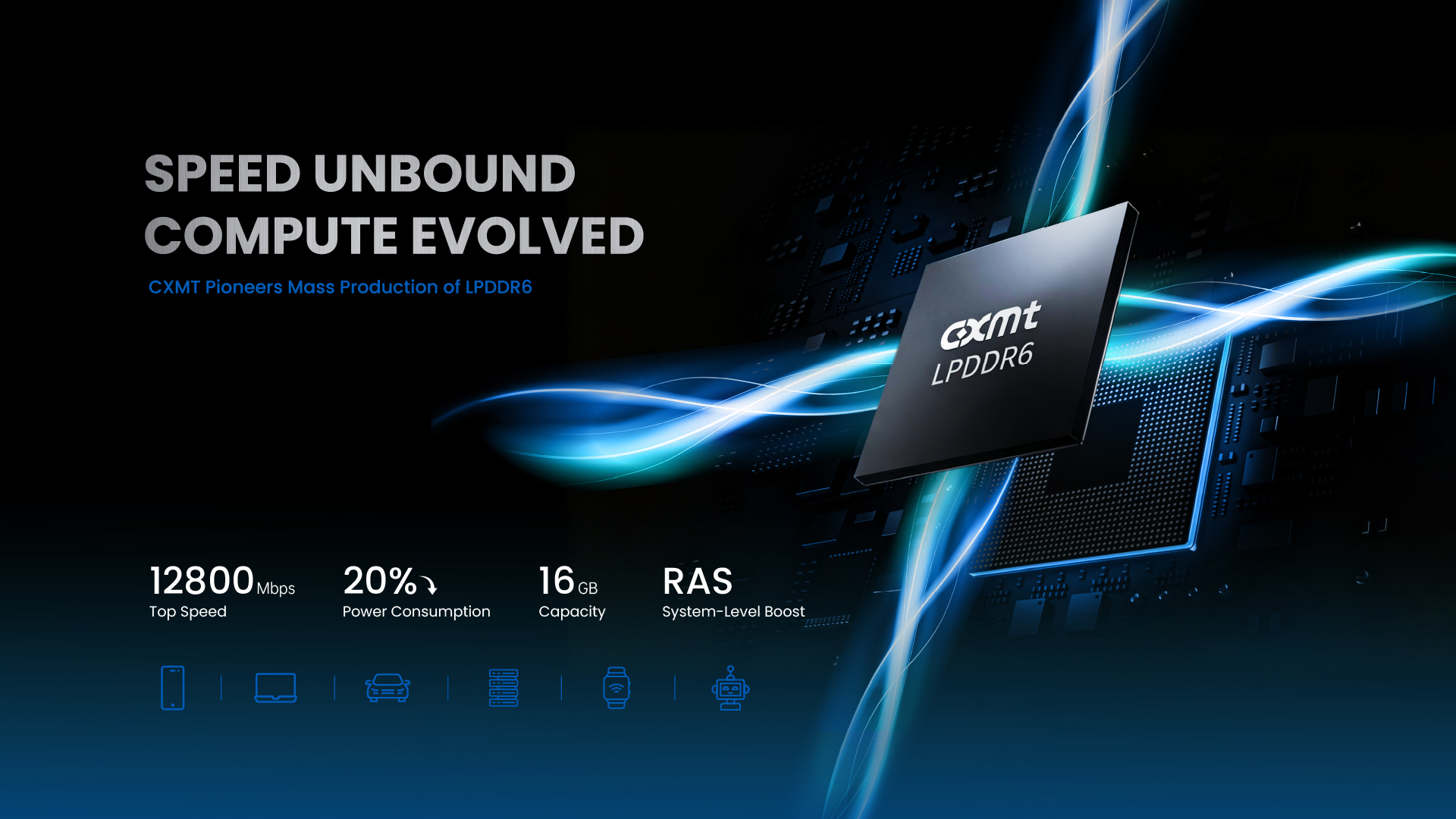
For the last two decades, anyone building a server, a NAS, or a workstation has effectively had three choices for DRAM: Samsung, SK hynix, or Micron. That list just grew. ChangXin Memory Technologies, the Chinese DRAM maker better known by its ticker CXMT, confirmed it has started mass production of LPDDR6 rated at 12,800 Mbps, according to TrendForce. The chips are already shipping inside Xiaomi's 18 Fold, and CXMT's general manager Zhao Lun said the company is "open to exploring partnerships with high-quality customers worldwide," which is corporate-speak for wanting a design win with Apple.
I don't cover phone SoCs for a living, and LPDDR6 in a foldable isn't going into anyone's Synology box. But market share for a new fab making JEDEC-compliant DRAM is the kind of thing that eventually trickles down to every DIMM I buy, and right now, in the middle of a DRAM price crisis that has already made 64GB DDR5 kits absurd, any credible new source of supply matters.
The Numbers
CXMT's LPDDR6 die runs at a peak 12,800 Mbps, with a more realistic SoC-paired operating speed of 10,667 Mbps. That's a 60% bump in peak bandwidth over LPDDR5X and a claimed 20% reduction in power draw. Capacity is 16Gb per die in a 1,295-ball FBGA package, fully compliant with the JEDEC LPDDR6 spec rather than a proprietary variant.
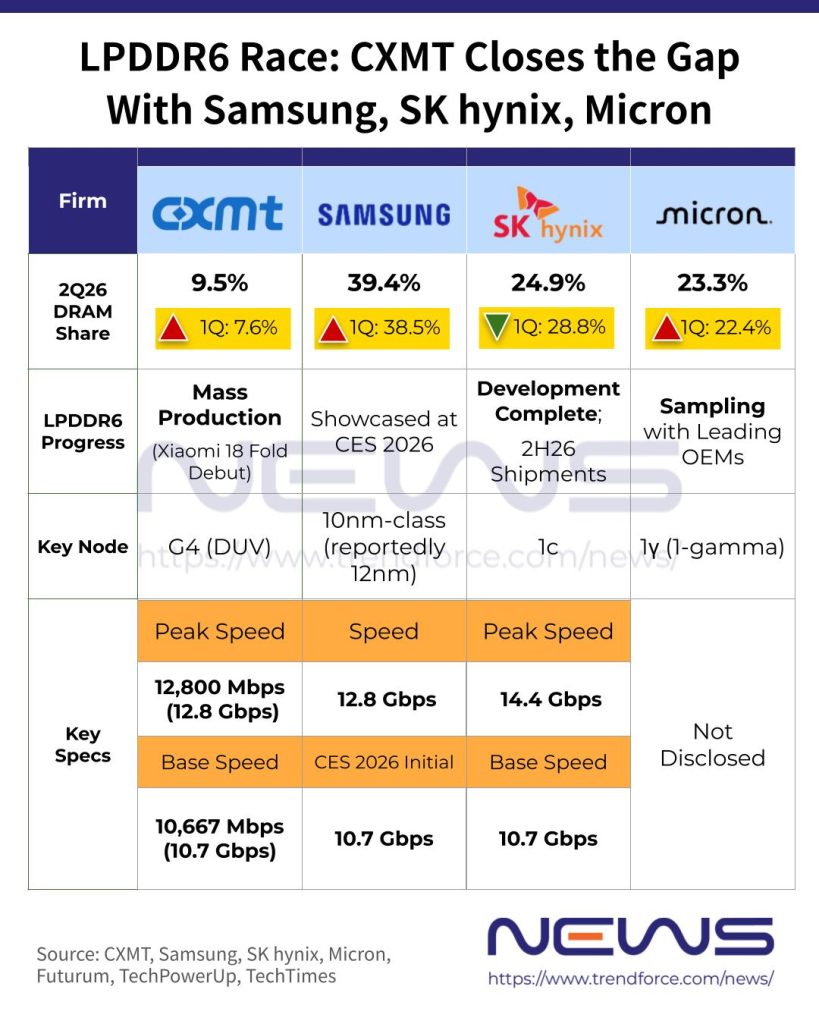
Put it next to the incumbents and CXMT isn't behind anymore. Samsung's 16Gb LPDDR6, shown at CES 2026, tops out at the same 12.8 Gbps on a 12nm process. SK hynix is currently shipping 16Gb parts at 10.7+ Gbps on its 1c (10nm-class) node and has stated a target of 14.4 Gbps for its next revision, with mass production slated for the second half of 2026. CXMT matching Samsung's peak rate on its first mass-produced LPDDR6 generation is not a rounding error. It's a company that spent years being dismissed as a legacy-node DDR4 supplier suddenly showing up at the leading edge.
Market Share Doesn't Lie
TrendForce's own numbers put CXMT's global DRAM revenue share at 9.5% in Q2 2026, up from 7.6% in Q1. That's still a distant fourth behind Samsung (39.4%), SK hynix (24.9%), and Micron (23.3%), but a nearly two-point jump in a single quarter, in an industry where fab capacity takes years to bring online, is a real trendline, not noise. CXMT says its capacity is booked at 95% utilization through 2027, and the company is pointing an estimated 600 million GB of potential China-market demand, roughly 50 million units at 12GB each, at whoever will take it.
RMB 9 billion of the RMB 29.5 billion CXMT raised in its IPO is earmarked for advanced DRAM R&D, with HBM called out as a priority. Translation: this isn't a company content to stay in the budget DDR4 lane forever. It wants a seat at the table where Samsung, SK hynix, and Micron have been quietly deciding how much of their capacity goes to AI accelerators versus the consumer DIMMs the rest of us actually buy.
Why a Fourth Supplier Matters to Anyone Running ECC
Here's my angle, because I don't care about phone SoC wins for their own sake. The entire reason DDR5 kits are running $17-plus per gigabyte right now is that Samsung, SK hynix, and Micron have all been diverting wafer capacity toward HBM for AI accelerators, since a stack of HBM4 prints more revenue per wafer than a stick of consumer DDR5 ever will. A credible fourth fab making standard JEDEC parts, with capacity that isn't chasing the same AI contracts, is one of the only structural things that could actually loosen that bottleneck instead of just waiting for Samsung's Pyeongtaek P5 line to come online in 2028.
But loosening supply and trusting the product are two separate questions, and I'm not conflating them. CXMT has a real track record on DDR4 and LPDDR4X at this point, but LPDDR6 mass production at scale is brand new, and there is zero multi-year field data on error rates, temperature behavior, or long-term degradation under sustained load. That's fine for a phone that gets replaced in three years. It is not fine for a server DIMM sitting behind ECC in a NAS that's supposed to catch bit flips silently, not generate them. I'll take cheaper DDR5 kits the day CXMT parts show up with an actual RDIMM track record and third-party validation from someone like Puget Systems or a memtest86 burn-in history I can point to. Until then, new silicon from a new fab goes through the same rule as everything else in my rack: run it, scrub it, verify it, and never let it be the only copy of anything that matters. No RAID is a substitute for backups, and no LPDDR6 press release is a substitute for years of uptime logs.
Loading comments...