
Directional Sensitivity Becomes the Headline
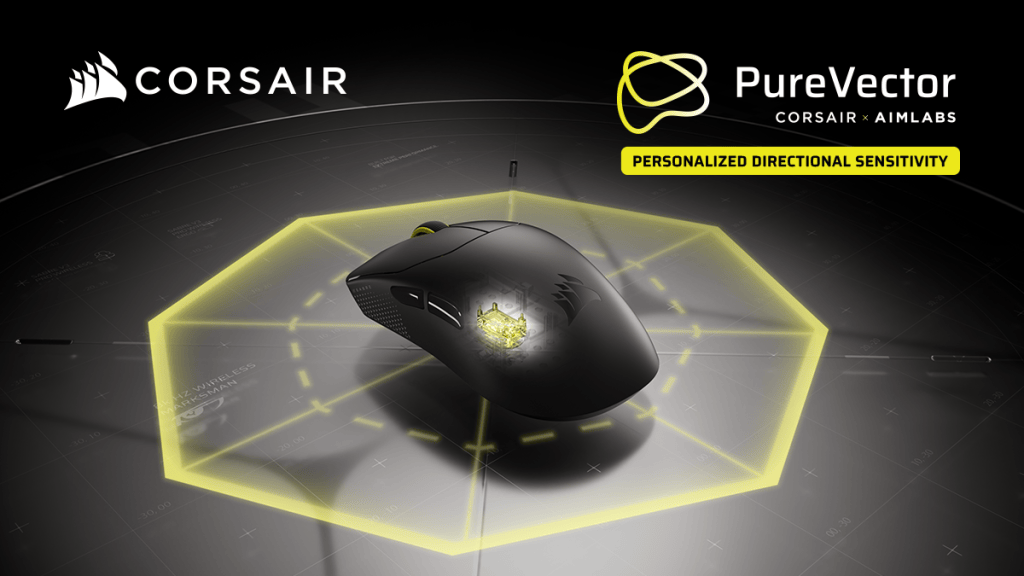
Corsair announced its Sabre v3 Pro PureVector series on October 20. Developed with Aimlabs, PureVector calibrates sensitivity by movement direction and stores the resulting profile in mouse firmware. That is a consequential adjustment for competitive players: your sensitivity becomes a directional mapping rather than one uniform setting. [Source: Corsair announcement](https://www.corsair.com/newsroom/press-release/corsair-changes-the-game-with-purevector-a-science-based-personalized-aiming-technology-launching-exclusively-in-the-sabre-v3-pro-purevector-mouse-series).
Faster Acquisition Needs Context
Corsair claims up to an 81ms reduction in aiming and correction time. This is a manufacturer result, not an independent benchmark or a reduction in electronic input latency. I would want repeated tests with calibration enabled and disabled, including target acquisition errors, before treating it as a competitive advantage.
A calibration routine can identify a weakness without proving that compensating for it transfers across games. My concern is repeatability: does the profile still help when your wrist position changes halfway through a match? Testing should include tracking as well as flicking, with the same pad and grip.
Weight Still Matters
The lineup offers symmetric and ergonomic shapes in ABS, magnesium alloy and carbon fiber. Corsair's published weights appear in the chart below. The lightest option is ABS, so buying the premium shell material does not buy the lowest mass. Shape and balance deserve hands-on evaluation before either material becomes a purchase argument.
The Cost of Maximum Polling
Corsair rates the Ultralight models for up to 140 hours at 1,000Hz and 25 hours at 8,000Hz. Those manufacturer estimates underpin the battery chart. An 8,000Hz report interval is 0.125ms, versus 1ms at 1,000Hz, but report timing alone cannot establish total click latency. I would test frame-time behavior alongside input measurements.
A $179.99 Experiment Worth Measuring
[Corsair's US storefront](https://www.corsair.com/us/de/p/gaming-mouse/CH-931G400-WW/sabre-v3-pro-ultralight-37g-wireless-gaming-mouse-black) lists the symmetric Ultralight at $179.99. At that price, directional calibration needs to earn its place through reproducible results. Every millisecond is a missed headshot, but a faster first movement only helps if the crosshair finishes on target.
Loading comments...