
A Failure on the Wrong Side of the Cable
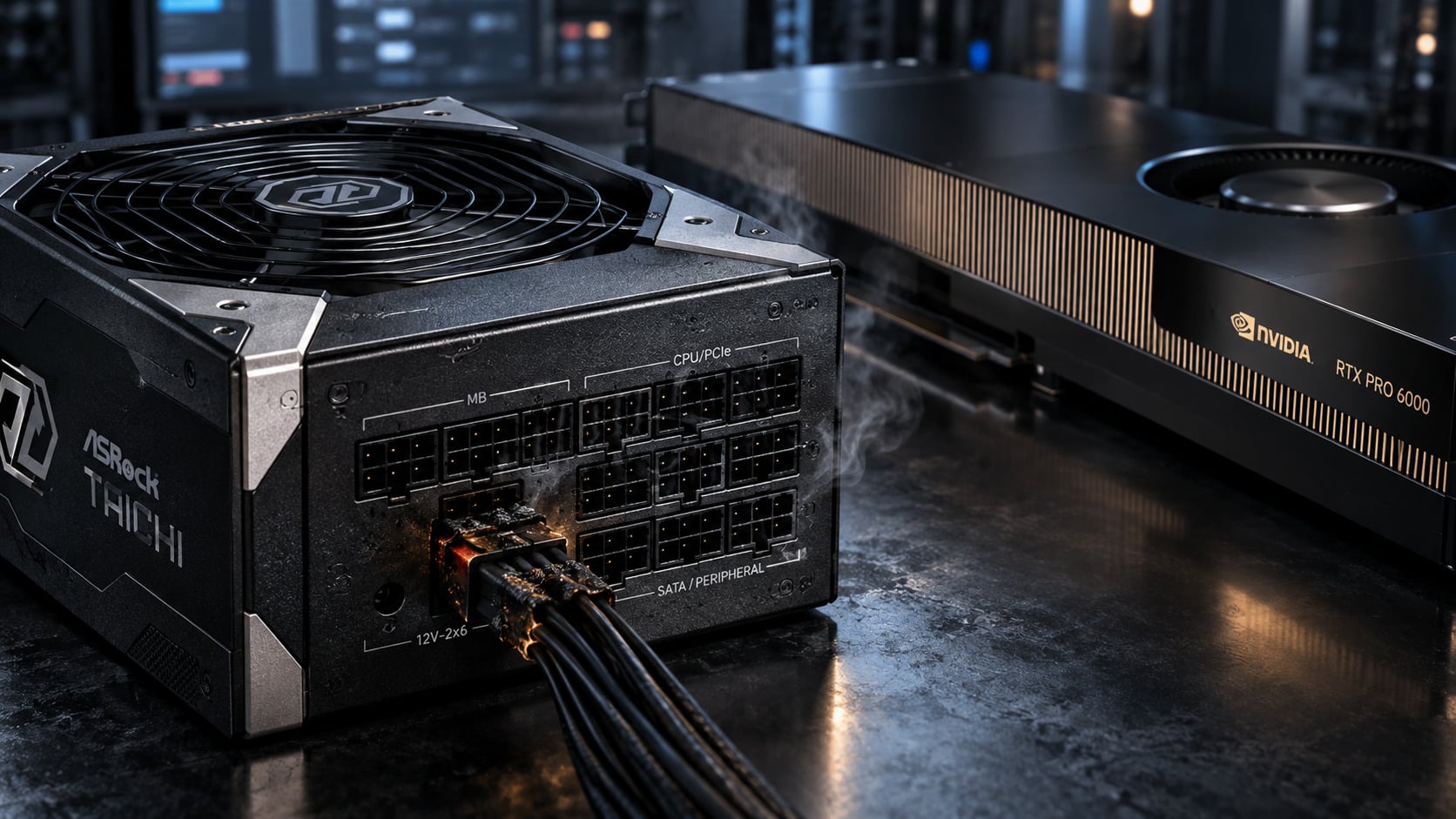
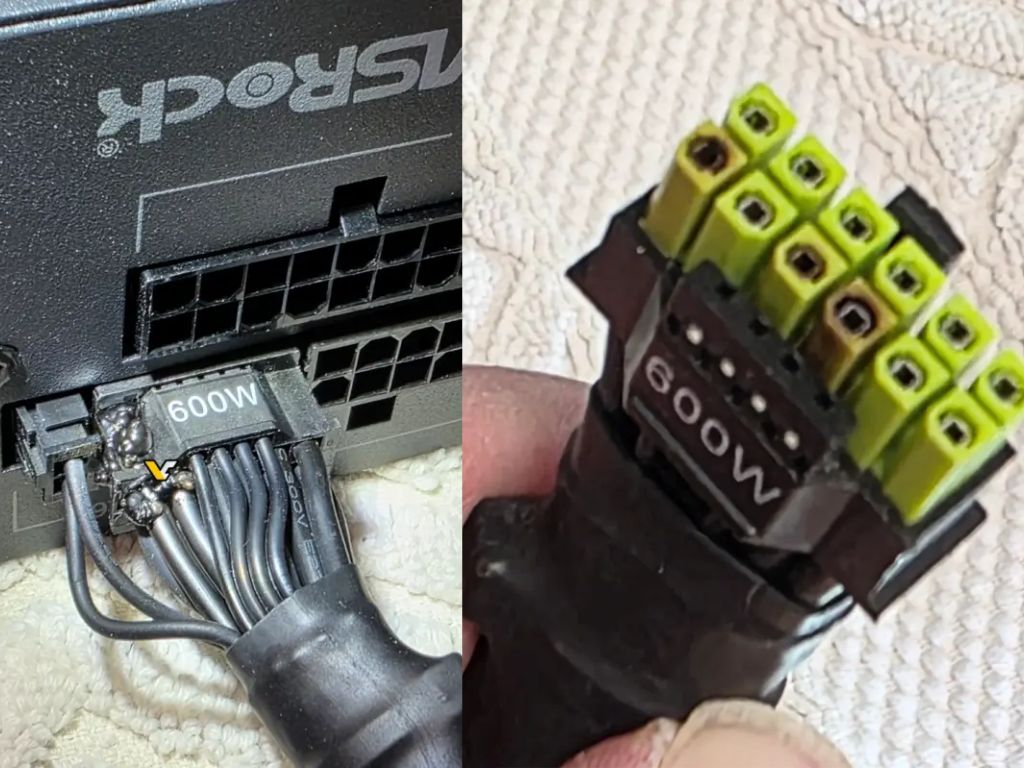
Most 12V-2x6 horror stories start at the GPU: a partially seated connector, a bent pin, a card drawing 575W through a socket the user thought clicked home. This one is different. The melted connector was on the power supply side of an ASRock Taichi TC-1650T, a 1650W, 80 PLUS Titanium, ATX 3.1 unit that ships with ASRock's own TempGuard active protection built in specifically to catch this failure mode before it happens. The load was an NVIDIA RTX PRO 6000, a 96GB workstation card with up to 600W of sustained draw and a street price north of $16,000. Both ends were reportedly seated correctly. The sensor did not stop it.
That detail is the whole story. TempGuard works by placing a thermal diode at the connector housing and cutting power when it reads a dangerous temperature. It is a reasonable design and I have no complaint with the concept, active protection is strictly better than none. But a sensor measures a point, not a junction. Resistive heating at a 12V-2x6 pin happens at the contact interface, inside the crimp, at a spot the external sensor cannot directly touch. By the time housing plastic reads hot enough to trip a shutdown, the actual fault point has often already been running well past its rating for a while. This is a sampling-rate and placement problem, not a software problem, and no amount of firmware tuning fixes a sensor that is physically downstream of the thing it is trying to catch.
Why the Card Itself Isn't the Anomaly
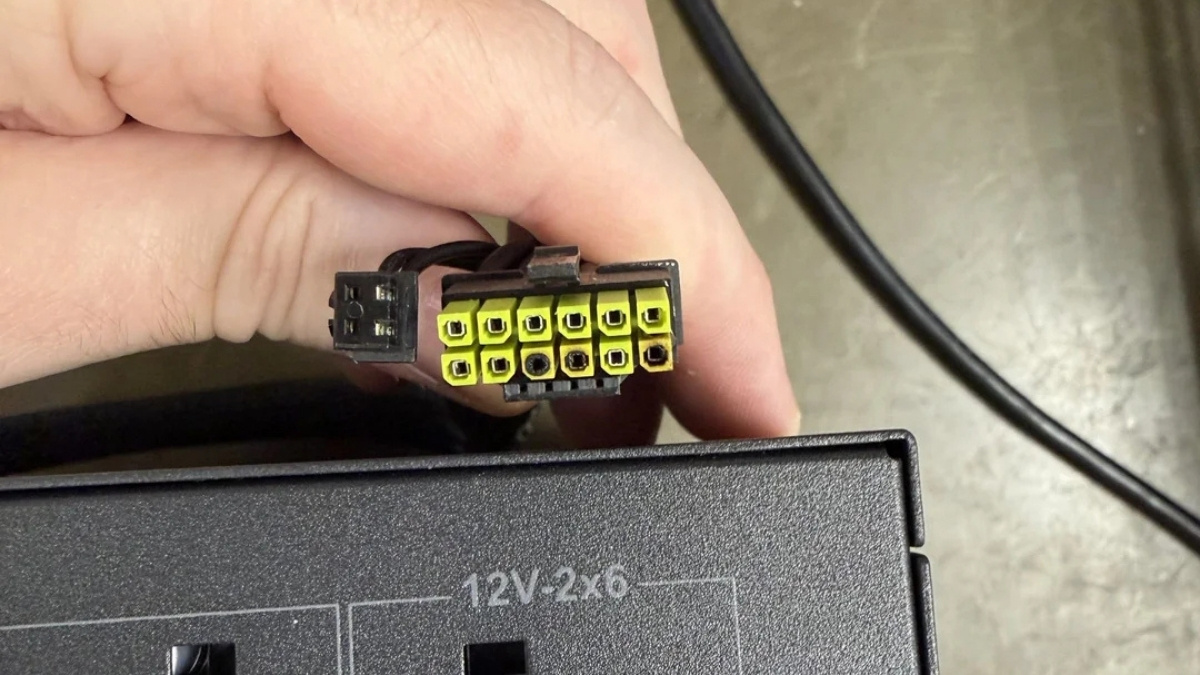
The RTX PRO 6000's 600W ceiling is not an outlier draw for a 12V-2x6 connector rated at exactly 600W continuous. That is zero margin by design. Compare it to the RTX 5090's 575W typical board power, also riding the same connector spec, also within single-digit percentage of the rated maximum. Every high-end card on this standard is operating at or near the connector's stated limit under sustained transient load, which is precisely the condition under which contact resistance, however small, turns into localized heat that compounds instead of dissipating. A connector spec with no headroom turns a manufacturing tolerance issue into a thermal event instead of a rounding error.
The Case and Airflow Side Nobody Talks About
What gets lost in every one of these writeups is that the PSU cable area sits in one of the worst-ventilated zones of most builds. It is behind a shroud, below the motherboard tray, often against a solid side panel with no direct airflow path at all. A modular cable connector relies almost entirely on passive convection and whatever stray air leaks past the PSU shroud cutout. Drop that connector two or three degrees above ambient because the case has no bottom intake and you have removed exactly the margin that was supposed to buy the sensor time to react. This is not a PSU problem in isolation, it is a system integration problem, and it is why I keep saying the same thing every time a case crosses my bench: airflow is not optional, it's physics. A Titanium-rated unit dumps less waste heat into the case than a Bronze unit at the same load, but less is not zero, and that heat has to go somewhere before it stacks on top of a marginal connection.
The Efficiency Tier Actually Matters Here
This is also a case where the 80 PLUS tier is not just a badge for the box. At 1650W of continuous output, the gap between Titanium and Bronze efficiency is the difference between roughly 163W and 362W of waste heat dumped directly into the PSU cavity and, by extension, into the cable compartment where these connectors live. That is not a rounding error, it is nearly a 200W swing in ambient load right next to the failure point in this story.
What This Means for High-Draw Builds
If you are running a 500W-plus card on a 12V-2x6 connector, treat active protection as a backstop, not a solution. Route the cable with a gentle bend radius, reseat it fully, and if your case does not move air through the PSU shroud cavity, that is worth fixing before you trust a temperature sensor to catch a problem in time. ASRock's TempGuard did its job in the sense that the failure stayed on the PSU side and did not take a $16,000 card with it. But 'the expensive part survived' is a low bar for a connector standard that is now three hardware generations old and still running with effectively no thermal margin.
Loading comments...